 Add to Chrome
 Add to Firefox
 Add to Edge
Thinking in Blender: Staged Executable Inverse Graphics with Vision-Language Models
Jun 01, 2026
Inverse graphics is a longstanding and highly underconstrained problem that seeks to reconstruct images as editable 3D scenes which can be rendered, relit, and manipulated. In this work, we investigate whether pretrained vision-language models (VLMs) can perform executable inverse graphics directly from a single image by reconstructing a scene as an editable Blender program, without relying on specialized 2D or 3D foundation models, differentiable rendering, or multi-view supervision. We introduce Staged Executable Inverse Graphics (SEIG), an agentic framework that reconstructs a 3D scene from a single image by progressively refining scene factors including geometry, materials, composition, and lighting directly in executable Blender code space. We evaluate our framework across diverse scenes using a range of reconstruction metrics spanning pixel-level, perceptual, and semantic fidelity. Our experiments show that staged reconstruction substantially improves reconstruction fidelity, highlighting the importance of task decomposition for executable inverse graphics with general-purpose VLMs. Finally, we showcase various downstream applications enabled by the reconstructed editable Blender scenes.

Seeing Fast and Slow: Learning the Flow of Time in Videos
Apr 23, 2026How can we tell whether a video has been sped up or slowed down? How can we generate videos at different speeds? Although videos have been central to modern computer vision research, little attention has been paid to perceiving and controlling the passage of time. In this paper, we study time as a learnable visual concept and develop models for reasoning about and manipulating the flow of time in videos. We first exploit the multimodal cues and temporal structure naturally present in videos to learn, in a self-supervised manner, to detect speed changes and estimate playback speed. We then show that these learned temporal reasoning models enable us to curate the largest slow-motion video dataset to date from noisy in-the-wild sources. Such slow-motion footage, typically filmed by high-speed cameras, contains substantially richer temporal detail than standard videos. Using this data, we further develop models capable of temporal control, including speed-conditioned video generation, which produces motion at specified playback speed, and temporal super-resolution, which tranforms low-FPS, blurry videos into high-FPS sequences with fine-grained temporal details. Our findings highlight time as a manipulable, perceptual dimension in video learning, opening doors to temporally controllable video generation, temporal forensics detection, and potentially richer world-models that understand how events unfold over time.
Imitating What Works: Simulation-Filtered Modular Policy Learning from Human Videos
Feb 13, 2026The ability to learn manipulation skills by watching videos of humans has the potential to unlock a new source of highly scalable data for robot learning. Here, we tackle prehensile manipulation, in which tasks involve grasping an object before performing various post-grasp motions. Human videos offer strong signals for learning the post-grasp motions, but they are less useful for learning the prerequisite grasping behaviors, especially for robots without human-like hands. A promising way forward is to use a modular policy design, leveraging a dedicated grasp generator to produce stable grasps. However, arbitrary stable grasps are often not task-compatible, hindering the robot's ability to perform the desired downstream motion. To address this challenge, we present Perceive-Simulate-Imitate (PSI), a framework for training a modular manipulation policy using human video motion data processed by paired grasp-trajectory filtering in simulation. This simulation step extends the trajectory data with grasp suitability labels, which allows for supervised learning of task-oriented grasping capabilities. We show through real-world experiments that our framework can be used to learn precise manipulation skills efficiently without any robot data, resulting in significantly more robust performance than using a grasp generator naively.
SAGE: Scalable Agentic 3D Scene Generation for Embodied AI
Feb 10, 2026Real-world data collection for embodied agents remains costly and unsafe, calling for scalable, realistic, and simulator-ready 3D environments. However, existing scene-generation systems often rely on rule-based or task-specific pipelines, yielding artifacts and physically invalid scenes. We present SAGE, an agentic framework that, given a user-specified embodied task (e.g., "pick up a bowl and place it on the table"), understands the intent and automatically generates simulation-ready environments at scale. The agent couples multiple generators for layout and object composition with critics that evaluate semantic plausibility, visual realism, and physical stability. Through iterative reasoning and adaptive tool selection, it self-refines the scenes until meeting user intent and physical validity. The resulting environments are realistic, diverse, and directly deployable in modern simulators for policy training. Policies trained purely on this data exhibit clear scaling trends and generalize to unseen objects and layouts, demonstrating the promise of simulation-driven scaling for embodied AI. Code, demos, and the SAGE-10k dataset can be found on the project page here: https://nvlabs.github.io/sage.
PolaRiS: Scalable Real-to-Sim Evaluations for Generalist Robot Policies
Dec 18, 2025A significant challenge for robot learning research is our ability to accurately measure and compare the performance of robot policies. Benchmarking in robotics is historically challenging due to the stochasticity, reproducibility, and time-consuming nature of real-world rollouts. This challenge is exacerbated for recent generalist policies, which has to be evaluated across a wide variety of scenes and tasks. Evaluation in simulation offers a scalable complement to real world evaluations, but the visual and physical domain gap between existing simulation benchmarks and the real world has made them an unreliable signal for policy improvement. Furthermore, building realistic and diverse simulated environments has traditionally required significant human effort and expertise. To bridge the gap, we introduce Policy Evaluation and Environment Reconstruction in Simulation (PolaRiS), a scalable real-to-sim framework for high-fidelity simulated robot evaluation. PolaRiS utilizes neural reconstruction methods to turn short video scans of real-world scenes into interactive simulation environments. Additionally, we develop a simple simulation data co-training recipe that bridges remaining real-to-sim gaps and enables zero-shot evaluation in unseen simulation environments. Through extensive paired evaluations between simulation and the real world, we demonstrate that PolaRiS evaluations provide a much stronger correlation to real world generalist policy performance than existing simulated benchmarks. Its simplicity also enables rapid creation of diverse simulated environments. As such, this work takes a step towards distributed and democratized evaluation for the next generation of robotic foundation models.
X-Diffusion: Training Diffusion Policies on Cross-Embodiment Human Demonstrations
Nov 06, 2025Human videos can be recorded quickly and at scale, making them an appealing source of training data for robot learning. However, humans and robots differ fundamentally in embodiment, resulting in mismatched action execution. Direct kinematic retargeting of human hand motion can therefore produce actions that are physically infeasible for robots. Despite these low-level differences, human demonstrations provide valuable motion cues about how to manipulate and interact with objects. Our key idea is to exploit the forward diffusion process: as noise is added to actions, low-level execution differences fade while high-level task guidance is preserved. We present X-Diffusion, a principled framework for training diffusion policies that maximally leverages human data without learning dynamically infeasible motions. X-Diffusion first trains a classifier to predict whether a noisy action is executed by a human or robot. Then, a human action is incorporated into policy training only after adding sufficient noise such that the classifier cannot discern its embodiment. Actions consistent with robot execution supervise fine-grained denoising at low noise levels, while mismatched human actions provide only coarse guidance at higher noise levels. Our experiments show that naive co-training under execution mismatches degrades policy performance, while X-Diffusion consistently improves it. Across five manipulation tasks, X-Diffusion achieves a 16% higher average success rate than the best baseline. The project website is available at https://portal-cornell.github.io/X-Diffusion/.
Prompting with the Future: Open-World Model Predictive Control with Interactive Digital Twins
Jun 16, 2025Recent advancements in open-world robot manipulation have been largely driven by vision-language models (VLMs). While these models exhibit strong generalization ability in high-level planning, they struggle to predict low-level robot controls due to limited physical-world understanding. To address this issue, we propose a model predictive control framework for open-world manipulation that combines the semantic reasoning capabilities of VLMs with physically-grounded, interactive digital twins of the real-world environments. By constructing and simulating the digital twins, our approach generates feasible motion trajectories, simulates corresponding outcomes, and prompts the VLM with future observations to evaluate and select the most suitable outcome based on language instructions of the task. To further enhance the capability of pre-trained VLMs in understanding complex scenes for robotic control, we leverage the flexible rendering capabilities of the digital twin to synthesize the scene at various novel, unoccluded viewpoints. We validate our approach on a diverse set of complex manipulation tasks, demonstrating superior performance compared to baseline methods for language-conditioned robotic control using VLMs.
X-Sim: Cross-Embodiment Learning via Real-to-Sim-to-Real
May 15, 2025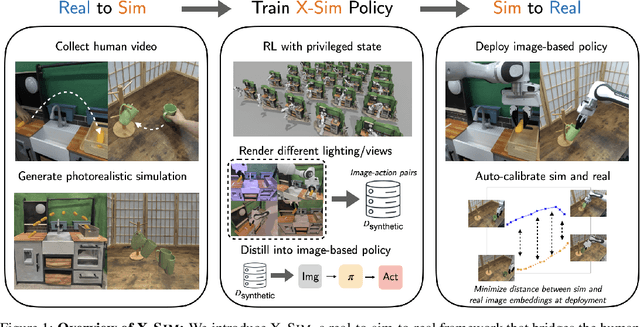
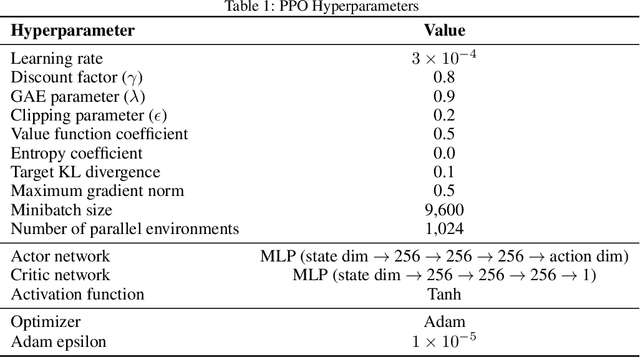
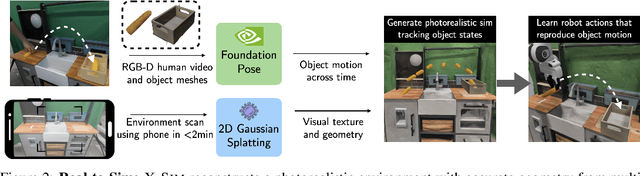
Human videos offer a scalable way to train robot manipulation policies, but lack the action labels needed by standard imitation learning algorithms. Existing cross-embodiment approaches try to map human motion to robot actions, but often fail when the embodiments differ significantly. We propose X-Sim, a real-to-sim-to-real framework that uses object motion as a dense and transferable signal for learning robot policies. X-Sim starts by reconstructing a photorealistic simulation from an RGBD human video and tracking object trajectories to define object-centric rewards. These rewards are used to train a reinforcement learning (RL) policy in simulation. The learned policy is then distilled into an image-conditioned diffusion policy using synthetic rollouts rendered with varied viewpoints and lighting. To transfer to the real world, X-Sim introduces an online domain adaptation technique that aligns real and simulated observations during deployment. Importantly, X-Sim does not require any robot teleoperation data. We evaluate it across 5 manipulation tasks in 2 environments and show that it: (1) improves task progress by 30% on average over hand-tracking and sim-to-real baselines, (2) matches behavior cloning with 10x less data collection time, and (3) generalizes to new camera viewpoints and test-time changes. Code and videos are available at https://portal-cornell.github.io/X-Sim/.
Eval3D: Interpretable and Fine-grained Evaluation for 3D Generation
Apr 25, 2025Despite the unprecedented progress in the field of 3D generation, current systems still often fail to produce high-quality 3D assets that are visually appealing and geometrically and semantically consistent across multiple viewpoints. To effectively assess the quality of the generated 3D data, there is a need for a reliable 3D evaluation tool. Unfortunately, existing 3D evaluation metrics often overlook the geometric quality of generated assets or merely rely on black-box multimodal large language models for coarse assessment. In this paper, we introduce Eval3D, a fine-grained, interpretable evaluation tool that can faithfully evaluate the quality of generated 3D assets based on various distinct yet complementary criteria. Our key observation is that many desired properties of 3D generation, such as semantic and geometric consistency, can be effectively captured by measuring the consistency among various foundation models and tools. We thus leverage a diverse set of models and tools as probes to evaluate the inconsistency of generated 3D assets across different aspects. Compared to prior work, Eval3D provides pixel-wise measurement, enables accurate 3D spatial feedback, and aligns more closely with human judgments. We comprehensively evaluate existing 3D generation models using Eval3D and highlight the limitations and challenges of current models.
DRAWER: Digital Reconstruction and Articulation With Environment Realism
Apr 22, 2025Creating virtual digital replicas from real-world data unlocks significant potential across domains like gaming and robotics. In this paper, we present DRAWER, a novel framework that converts a video of a static indoor scene into a photorealistic and interactive digital environment. Our approach centers on two main contributions: (i) a reconstruction module based on a dual scene representation that reconstructs the scene with fine-grained geometric details, and (ii) an articulation module that identifies articulation types and hinge positions, reconstructs simulatable shapes and appearances and integrates them into the scene. The resulting virtual environment is photorealistic, interactive, and runs in real time, with compatibility for game engines and robotic simulation platforms. We demonstrate the potential of DRAWER by using it to automatically create an interactive game in Unreal Engine and to enable real-to-sim-to-real transfer for robotics applications.